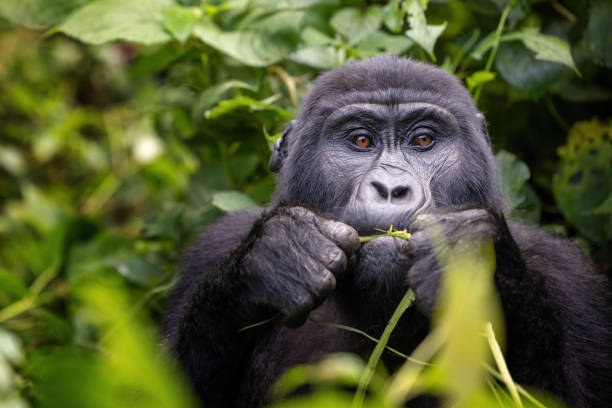
Gorilla trekking in Bwindi Impenetrable Forest is one of Africa's most extraordinary wildlife experiences. Deep in southwestern Uganda, ancient rainforest rises across steep mountain slopes, creating a spectacular habitat for the endangered mountain gorilla. A trek here is not simply a wildlife excursion—it is an immersive journey through one of Uganda's most remarkable ecosystems and an opportunity to observe a wild gorilla family in its natural environment.
For travelers planning their first gorilla adventure, Bwindi can raise many questions: Where is the park? How much does gorilla trekking cost? How difficult is the hike? What should you pack? Which sector should you choose? When is the best time to visit?
This ultimate guide answers those questions and explains everything you need to know before booking your Bwindi gorilla trekking safari with JM Jungle Safaris.
What Is Gorilla Trekking in Bwindi?
Gorilla trekking is a guided walking experience in which visitors enter the forest in search of a habituated mountain gorilla family.
Unlike a conventional game drive, where you remain in a safari vehicle, gorilla trekking takes place on foot. You follow trails through dense vegetation, across uneven ground and sometimes up or down steep slopes while trackers help locate the gorilla family.
Once the gorillas are found, visitors spend a regulated period observing them before returning through the forest.
The experience can involve anything from a relatively short forest walk to several hours of challenging hiking. Because gorillas are wild animals and move freely through their habitat, the exact trekking route and duration cannot be predicted in advance.
Where Is Bwindi Impenetrable Forest?
Bwindi Impenetrable National Park is located in southwestern Uganda, near the borders with Rwanda and the Democratic Republic of the Congo.
The park forms part of the Albertine Rift and is characterized by steep terrain, dense rainforest and remarkable biological diversity.
Bwindi's location makes it possible to combine gorilla trekking with other Ugandan destinations such as:
- Queen Elizabeth National Park
- Kibale National Park
- Lake Bunyonyi
- Mgahinga Gorilla National Park
- Lake Mburo National Park
- Entebbe and Kampala
Why Is Bwindi Called "Impenetrable"?
The name Bwindi is associated with the local word Mubwindi, commonly interpreted in relation to darkness.
The forest certainly lives up to its reputation.
Its dense vegetation includes tangled vines, thick undergrowth, ferns, bamboo and enormous forest trees. In some places, sunlight struggles to penetrate the canopy.
This dense environment is precisely what makes the gorilla experience so special.
You aren't simply arriving at an enclosure where gorillas are waiting.
You enter their forest.
Why Is Bwindi Famous for Gorilla Trekking?
Bwindi is one of the world's most important habitats for mountain gorillas.
Uganda Wildlife Authority states that Uganda is home to more than half of the world's remaining mountain gorillas, with Bwindi and Mgahinga forming Uganda's principal mountain-gorilla destinations.
The gorillas live in family groups led by dominant silverbacks.
A typical encounter may involve seeing:
- Silverbacks
- Adult females
- Juveniles
- Infants
- Blackbacks
- Feeding gorillas
- Resting gorillas
- Grooming behaviour
- Playful young gorillas
- Every encounter is different because the animals determine what happens.
One day a gorilla family may be feeding quietly.
Another day the juveniles may be climbing and playing.
A silverback may sit just metres away while the rest of the family moves through the vegetation.
Gorilla Trekking vs Gorilla Habituation Experience
Uganda offers two distinct ways of experiencing habituated gorillas.
Gorilla Trekking
The standard gorilla trekking experience involves following a habituated gorilla family and spending a regulated period observing the group.
It is suitable for most travelers who want to experience mountain gorillas without dedicating an entire day to the forest.
Gorilla Habituation Experience
The habituation experience provides an extended opportunity to spend time with a gorilla group undergoing habituation.
It involves a smaller number of visitors and a longer observation period.
The experience is particularly attractive to travelers who are passionate about wildlife behaviour, conservation and photography.
Because permits, availability and regulations can change, your safari operator should confirm the current arrangements with Uganda Wildlife Authority before booking.
Bwindi Gorilla Trekking Sectors
Bwindi is divided into several tourism sectors.
The main trekking sectors include:
Buhoma
Located on the northern side of Bwindi, Buhoma is the historic and one of the best-known gorilla trekking areas.
It offers access to gorilla trekking as well as forest walks and community experiences.
Ruhija
Ruhija lies in the eastern part of Bwindi and is surrounded by beautiful forest and rolling highland landscapes.
It is also known for birding.
Rushaga
Rushaga is situated in the southern part of Bwindi and offers gorilla trekking as well as habituation experiences.
Nkuringo
Nkuringo lies in the southern sector and is known for spectacular views toward the Virunga volcanoes.
The terrain can be challenging, but the scenery is exceptional.
Which Bwindi Sector Should You Choose?
There is no single sector that is universally best for every traveler.
Your choice should depend on:
- Gorilla permit availability
- Where you are coming from
- Where you are going afterward
- Your accommodation preferences
- Physical fitness
- Desired activities
- Budget
- Whether you want standard trekking or habituation
- The overall safari route
For example, if your itinerary approaches Bwindi from Queen Elizabeth National Park, Buhoma or the appropriate southern sector may make sense depending on the exact route.
If you are coming from Kisoro or Mgahinga, southern Bwindi sectors can be logistically convenient.
A good safari operator should design the accommodation and transportation around your permit sector, rather than choosing a lodge first and creating unnecessary driving afterward.
How Difficult Is Gorilla Trekking?
This is one of the most important questions to ask before booking.
Gorilla trekking can be physically demanding.
Bwindi is a mountainous rainforest environment. Trails may involve:
- Steep climbs
- Descents
- Mud
- Slippery ground
- Dense vegetation
- Tree roots
- Uneven terrain
- Narrow trails
However, the difficulty varies considerably from one trek to another.
The gorillas may be close to the starting point on one day and much farther away on another.
Can older travelers trek gorillas?
Age alone does not determine whether someone can trek.
What matters is overall mobility, fitness and ability to walk on uneven terrain.
Travelers with limited mobility should discuss their circumstances with their safari operator before booking so that appropriate arrangements can be explored.
How Long Does Gorilla Trekking Take?
There is no fixed trekking duration.
The total experience can vary depending on:
- Where the gorilla family is located
- Terrain
- Weather
- Gorilla movements
- Tracking conditions
- Fitness of the group
Some treks may take only a few hours, while others can take much longer.
The important thing is to approach the trek as a full-day outdoor experience, rather than expecting an exact timetable.
How Close Can You Get to the Gorillas?
Gorilla encounters are carefully regulated.
Visitors must follow Uganda Wildlife Authority's rules concerning distance, behaviour, photography and interaction with the gorillas.
The purpose is to minimize disturbance and protect both the animals and visitors.
Your ranger and trackers are there not only to locate the gorillas but also to guide the group on how to behave around them.